
Acoustic monitoring as a tool for ornithological assessment
Over recent years, BiOME has increasingly been commissioned to undertake acoustic monitoring in support of ornithological assessments across a wide range of projects. In most cases, acoustic monitoring forms part of a broader evidence base, complementing traditional survey methodologies.
As acoustic monitoring has become more widely used within ornithological assessment, BiOME has continued to develop its in-house expertise to deliver these surveys and bioacoustic data interpretation, supporting its effective integration alongside traditional survey methods.
Autonomous recording devices are deployed at selected locations and programmed to record automatically at times tailored to the survey objectives. This approach captures activity that can be difficult to detect through traditional survey methods and is particularly effective for recording cryptic or otherwise elusive species, including owls and other nocturnal or crepuscular birds, as well as species that vocalise infrequently.
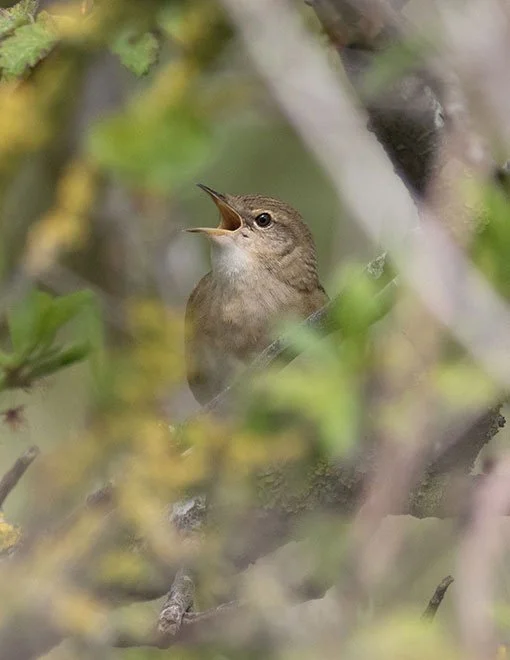
Singing Grasshopper Warbler Locustella naevia; a secretive, skulking species typically most active in the late evening, and often singing through the night to first light
© David Bratt
Acoustic monitoring is an increasingly valuable tool in ornithological assessment, enabling bird vocalisations to be recorded over extended periods, in remote locations, during twilight and throughout the hours of darkness, all with minimal disturbance. Our devices have been deployed for a variety of purposes, including:
assessing the presence of breeding Stone-curlew Burhinus oedicnemus and Nightjar Caprimulgus europaeus, and identifying foraging areas;
monitoring passage wader and wildfowl activity along migration corridors during key passage periods;
targeting individual species such as Spotted Crake Porzana porzana, Golden Oriole Oriolus oriolus, Lesser Spotted Woodpecker Dryobates minor and Quail Coturnix coturnix;
to provide supplementary data on the status and distribution of all species, sampling particular habitats or targeting areas receiving reduced coverage from other survey methodologies.
Throughout recent seasons BiOME has collected substantial quantities of acoustic data and following device retrieval, recordings are run through automated classifiers to analyse the data for species-level predictions. To achieve this, recordings are processed through deep learning-based bioacoustic models, trained on large audio datasets. The predictions made by the classifier are evaluated alongside historical survey data, specific to the location and time of year and the results of the automated classification are then analysed by expert ornithologists.
The growing use of acoustic monitoring reflects a broader shift towards data-rich ornithological assessment. By combining extended-duration recording, automated analysis and expert ecological interpretation, these methods can provide detailed evidence across spatial and temporal scales that would be difficult to achieve through traditional survey techniques alone. As part of an integrated survey approach, acoustic monitoring is becoming an increasingly important component of modern ornithological assessment.